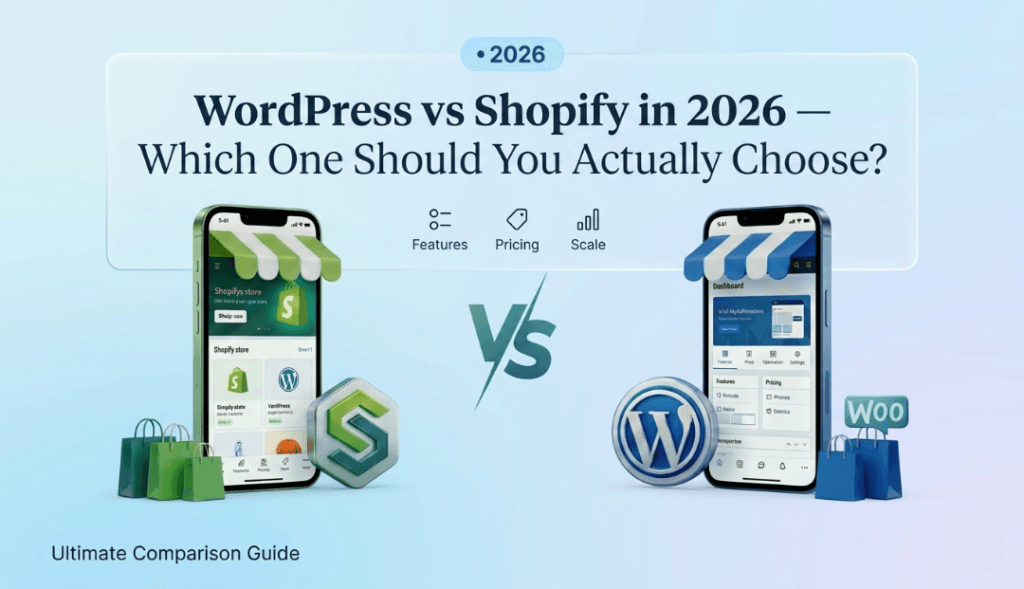
You are ready to launch an online store and keep hitting the same wall WordPress or Shopify? Every article tells you something different. Shopify is easier. WordPress is better for SEO. Nobody gives you the complete picture. I have built WooCommerce stores for clients worldwide and helped businesses through costly Shopify to WordPress migrations. Here is the honest comparison between WordPress vs Shopify 2026 most guides are afraid to write.
The One Thing Most Comparisons Get Wrong
Before the feature tables, here is what 95% of WordPress vs Shopify comparisons miss:
The best platform is not the one with the most features. It is the one that matches how your business actually grows.
A first-time seller launching a 10 product dropshipping store needs something completely different from a content driven brand building topical authority on Google for 50 keywords. This guide will help you identify which model fits your business so you make the right decision before spending months on the wrong platform.
Quick Comparison WordPress vs Shopify 2026 Data
| Feature | WordPress + WooCommerce | Shopify |
|---|---|---|
| Platform cost | FREE | $39/month ($468/year) |
| Realistic year-1 total | $200 — $600 | $700 — $1,800 |
| Transaction fees | None | 0.5% — 2% per sale |
| Setup difficulty | Medium | Easy |
| SEO control | ⭐⭐⭐⭐⭐ | ⭐⭐⭐ |
| Customization | Unlimited | Limited |
| Blog capability | ⭐⭐⭐⭐⭐ | ⭐⭐⭐ |
| Mobile Core Web Vitals pass rate | 44% of sites | 65% of sites |
| Data ownership | 100% yours | Shopify platform |
| AI features 2026 | Growing ecosystem | Shopify Magic — strong |
| Pakistan payment gateways | JazzCash, EasyPaisa, Stripe, PayPal | Stripe, PayPal only |
| Monthly maintenance | Required | Handled by Shopify |
Real Cost Comparison The Numbers Most Guides Hide
Shopify What You Actually Pay in Year 1
| Cost Item | Annual Amount |
|---|---|
| Basic plan ($39/month) | $468 |
| Domain name | $14 |
| Essential apps — email, reviews, SEO | $240 — $600 |
| Transaction fees at $10K/month revenue (2% Basic plan) | $2,400/year |
| Realistic Year 1 Total at $10K/month revenue | $3,122 — $3,482 |
WordPress WooCommerce What You Actually Pay in Year 1
| Cost Item | Annual Amount |
|---|---|
| WordPress + WooCommerce | FREE |
| Domain name | $13 — $15 |
| Business hosting (Hostinger) | $60 — $120 |
| Essential plugins — SEO, security, backup | $100 — $200 |
| Developer setup (one-time) | $99 — $200 |
| Transaction fees | $0 |
| Realistic Year 1 Total | $272 — $535 |
The number nobody talks about: At $10,000 monthly revenue, Shopify Basic plan transaction fees cost $2,400 per year. That is enough to pay for a professionally built WooCommerce store plus three years of hosting. As revenue grows, this gap compounds dramatically.
SEO Comparison Real 2026 Data
SEO is the most important factor for businesses that want organic Google traffic without paying for ads every month.
Technical SEO
WordPress:
- Complete URL control you choose every URL structure
- Rank Math gives you the deepest on page SEO control available on any platform
- Full schema markup control products, FAQs, articles, reviews
- Unlimited content taxonomies nested categories, tags, custom post types
- WordPress powers content led SEO better than any other platform
Shopify:
- Fixed URL structure
/products/and/collections/cannot be changed - Good built in SEO defaults sitemaps, SSL, canonical tags automatic
- Significantly improved SEO tools in 2026 Shopify has closed the gap on basics
- Fixed URL structure actually prevents common SEO mistakes beginners make
Verified 2026 data: According to HTTP Archive analysis from early 2026, Shopify stores achieve a median LCP of 1.9 seconds versus 2.8 seconds for WordPress. However, 65% of Shopify mobile sites pass all three Core Web Vitals compared to only 44% of WordPress sites. Shopify’s default performance is stronger out-of-the-box. A properly optimized WordPress site on good hosting matches it but optimization requires deliberate effort that Shopify handles automatically.

Content and Blog Capability
This is where the gap is real and significant for any business building organic traffic.
WordPress: Built as a content management system before it was ever an eCommerce platform. Full nested categories, topic clusters, pillar pages, advanced internal linking, unlimited custom post types WordPress is the undisputed best platform for content-driven SEO strategies.
Shopify: Blog exists and works. But no nested categories, limited content architecture, and building topical authority requires workarounds that WordPress handles natively.
The honest 2026 verdict on SEO as confirmed by multiple independent analyses: WooCommerce for content-led SEO. Shopify for product led SEO. If your business generates organic traffic primarily through blog content and topic clusters, WordPress has a structural advantage. If your SEO strategy is product-page and collection-page focused, Shopify performs equally well.
The Unique Angle What Happens After Year Three
This is the most important factor for long-term business planning and 99% of comparison guides completely skip it.
The Shopify Lock-In Problem
After three years on Shopify, here is what typically happens to content-focused businesses:
- The store does well and the team decides to invest seriously in SEO content
- Shopify’s blog limitations block the content architecture they need
- They decide to migrate to WordPress and discover migration costs $2,000-$8,000 depending on store size
- Migration risks losing 20-40% of existing Google rankings during the transition period
- Recovery takes 3-6 months minimum
Every business that migrates from Shopify to WordPress for SEO reasons is a business that would have been better served by WordPress from day one. The $400-600 saved in year one on setup costs can cost $5,000-10,000 in year three migration expenses plus months of ranking recovery.
WordPress The Compound Advantage
A WordPress website grows more powerful over time:
- Every blog post compounds in Google rankings month after month
- Internal links grow stronger as the content library grows
- Topical authority builds new posts rank faster as domain authority increases
- All of this value is 100% yours nobody can change pricing or terms and take it away
Platform Ownership The Conversation Nobody Has
WordPress: You own the software, the content, the database, the design everything. You can change hosting companies, switch developers, export all data, or host it yourself. Your business assets belong entirely to you.
Shopify: You are a tenant in Shopify’s ecosystem. Shopify raised Basic plan pricing from $29 to $39 in 2023. If they raise it again or discontinue features you rely on, you have no recourse. Checkout customization beyond basic settings requires Shopify Plus at $2,300+/month. Your business depends on Shopify’s roadmap and decisions.
For a business you are building for the long term, full ownership matters.
Pakistan Payment Gateway Comparison
This is a critical factor that most international comparison guides ignore entirely and it directly affects Pakistani eCommerce businesses.
| Payment Gateway | WordPress WooCommerce | Shopify |
|---|---|---|
| JazzCash | ✅ Full native support | ⚠️ Third-party app only, limited |
| EasyPaisa | ✅ Full native support | ⚠️ Very limited, not officially supported |
| HBL Pay | ✅ Available | ❌ Not available |
| Meezan Bank | ✅ Available | ❌ Not available |
| Shopify Payments | ❌ N/A | ❌ Not available in Pakistan |
| PayPal | ✅ Available | ✅ Available |
| Stripe | ✅ Available | ✅ Available |
| Transaction fees | None | 0.5% — 2% per sale |
For Pakistani businesses selling locally, WooCommerce is the clear choice. The local payment gateway support is dramatically better and transaction fees are zero.
Shopify’s 2026 AI Features Honest Assessment
Shopify Magic has genuinely expanded in 2026. It now covers product description generation, email campaign content, blog post drafts, and customer segmentation all natively without additional tools. Shopify also introduced Agentic Storefronts in 2026, which helps merchants appear in AI-powered search results from tools like ChatGPT and Perplexity.
These are real advantages for product-focused merchants who want automation without plugin management.
WordPress’s AI ecosystem in 2026 is strong but plugin-dependent. Tools like Rank Math AI, Elementor AI, and third-party integrations provide similar capabilities but require setup and configuration that Shopify handles automatically.
The honest take: For merchants prioritizing AI powered product commerce, Shopify’s 2026 features are genuinely compelling. For businesses where content strategy drives customer acquisition, WordPress still has the structural advantage.
The Decision Framework
Answer these five questions honestly before choosing:
| Question | If Yes → |
|---|---|
| Do you want to rank on Google through blog content and topic clusters? | WordPress |
| Are you selling in Pakistan and need JazzCash or EasyPaisa? | WordPress |
| Are you doing $5,000+/month revenue and paying Shopify transaction fees? | Switch to WordPress |
| Do you want zero technical maintenance updates, security, hosting managed for you? | Shopify |
| Are you a complete beginner wanting to launch a simple store in under 48 hours? | Shopify |
If you answered WordPress to three or more the choice is clear.

What Top Ranking Blogs Get Wrong About This Comparison
After researching the top-ranking articles on this topic, here is what most miss:
They compare unoptimized WordPress to Shopify’s managed infrastructure. The speed comparison is fair when you put optimized WordPress on good hosting against Shopify. The 44% vs 65% Core Web Vitals pass rate reflects the average WordPress install not a properly optimized one.
They ignore the maintenance time cost. WooCommerce requires 2-4 hours of monthly maintenance plugin updates, compatibility testing, security checks. Shopify handles this automatically. For solo business owners, this time cost is real and should factor into the decision.
They do not mention the compounding transaction fee problem. Most comparisons show year-one cost only. At $100,000 annual revenue on Shopify Basic, transaction fees cost $2,000 per year. Over five years that is $10,000 enough to pay for a premium WooCommerce store multiple times.
Frequently Asked Questions
Q: Is WooCommerce actually free? A: WooCommerce itself is completely free. You pay for domain ($13-15/year), hosting ($60-120/year), and any premium plugins you choose. Total annual cost for a basic store is $200-400 compared to Shopify’s $468 minimum before apps and transaction fees.
Q: Which is better for beginners in 2026? A: Shopify is easier for complete beginners to set up without help. If you hire a WordPress developer to set up WooCommerce, daily management becomes equally straightforward. The setup difficulty is a one time problem. The cost and SEO advantages are permanent.
Q: Can I migrate from Shopify to WordPress later? A: Yes, but it costs $2,000-$8,000 depending on store size and typically takes 2-6 weeks. You also risk losing rankings during the transition. Making the right platform choice from the beginning is significantly cheaper than migrating later.
Q: Does Shopify work for businesses in Pakistan? A: It works but with real limitations. Shopify Payments is unavailable in Pakistan. JazzCash and EasyPaisa have very limited or no official Shopify support. You pay extra transaction fees on every sale using third party gateways. For Pakistani businesses selling locally, WooCommerce is the practical choice.
Q: Which platform is better for dropshipping? A: Shopify has better native integrations with dropshipping suppliers for pure product dropshipping. For dropshipping combined with content marketing and SEO, WordPress is the better long term choice.
Q: How much does it cost to build a WooCommerce store? A: A professional WooCommerce store built by a skilled developer starts from $99 for a basic setup. A full custom store with payment gateway integration, SEO setup, and speed optimization runs $200-400. Check my pricing packages for exact figures.
The Honest Verdict
Choose Shopify if: You are a complete beginner, you want to launch in 48 hours, you rely primarily on paid ads, your blog is secondary, and you want zero technical maintenance.
Choose WordPress WooCommerce if: You are serious about SEO and organic traffic, you want content that compounds over time, you sell in Pakistan and need local payment gateways, you want complete platform ownership, and you are building a long-term business.
Most businesses I work with both in Pakistan and internationally are better served by WordPress. The SEO advantage, zero transaction fees, and complete ownership make it the right long-term choice for any business building seriously online.
Want a professional WooCommerce store? View my WordPress website services or contact me for a free consultation. Packages start from $99.
Written by Raja Saeed Freelance WordPress Developer and WooCommerce expert with 3+ years of experience building eCommerce stores for businesses in Pakistan and internationally. rajasaeedweb.com